By Ron Miller
This piece was shared with Ron Miller’s World in 2023 by former LFC student Tom Meier. Tom and Ron shared a great friendship and Tom was a good family friend to me as well. We cannot pinpoint the exact year Ron wrote this article but it was sometime in the mid-to-early 90’s. We hope you enjoy and thank you so much to Tom for sharing this with us.
Introduction
When I was a young Jesuit seminarian, I saw the world in terms of a battle being waged. The battle was between the truth of Roman Catholic Christianity and all other forms of half truth or total error. When still a high school student at a Jesuit school, I can remember how lustily we sang: “An army of youth, flying the standards of truth, we’re fighting for Christ the Lord; heads lifted high, Catholic Action our cry, and the cross our only sword.” The song went on to refer to the “earth’s battlefield” where this spiritual warfare was being waged. St. Ignatius of Loyola, the founder of the Jesuits, wrote in his Spiritual Exercises that Christ the King addresses his potential followers with the words: “It is my will to conquer the whole world and all my enemies, and thus to enter into the glory of my Father.” To fight under the King’s standard was a holy calling.
It is now more than twenty years since I left the Jesuits but I still see the world as a battlefield sometimes, though the battle I recognize today is not one being fought for Catholicism or Judaism or Buddhism or for any other of the competing “-ism’s” of our ideological landscape. It is rather a battle for spirit, for an alternative to a numbing and reductionistic secular culture. Spirit has indeed been sucked from our socialized world and we are gasping again for that breath God once puffed into Adam’s clay; we are seeking some breeze of that holy spirit that once moved so mightily over creation’s waters. Like the deer of Psalm 42 thirsting for running water, so do our souls thirst for living spirit.
Our society seems so often spiritless, crabbed and cramped in its materialistic wrappings. Many of us find ourselves longing to recover spirit in our workplace and indeed in all aspects of our living space. We thirst to sink our roots down into what the fourteenth-century German mystic Meister Eckhart referred to as a divine river coursing clear underneath our arid and superficially surfaced world, those depths that the poet-priest Gerard Manley Hopkins called “the dearest freshness deep down things.” We recognize all too clearly the pervading malady, the “loss of soul” that Thomas Moore describes so well in his deservedly popular Care of the Soul. We seek room to stretch, space for spirit.
A Context of Dialogue
Towards the end of Rabbi Harold Kushner’s latest book, To Life! A Celebration of Jewish Being and Thinking, he talks about a congregant chiding him for the fact that he was going to visit a Christian church where he would be speaking “for the competition.” But Kushner responds that Christianity is not the competition; apathy, selfishness, and all that denies the transcendent in our nature and our life—they are the competition. He concludes by saying that the church and the synagogue are allies; they are on the same side of the battle. No words could better express my own feelings on the matter. Spiritual paths should not be seen in competition but rather as spokes in the same wheel, leading to the same hub, the same reality of spirit.
Andrew Harvey makes the same point in his book, The Way of Passion, an enthusiastic introduction to the mystical poetry of the great Sufi, Jalal al-Din, popularly known as Rumi. Harvey quotes one of Rumi’s poems where he asserts that he is neither Christian nor Jew, not a Zoroastrian nor even a Muslim. He proclaims himself rather to be in “astounding lucid confusion” and asks us not to nail him down in a box of cold words. Harvey uses this line as a springboard to his own assertion that we should not be trapped in our diverse religious identities. For we are really “using a particular sacred way to get to the placeless, the nameless, and the wayless.” We should be using the “sacred technology” that speaks to us but not be caught in labels. Again, like Rabbi Kushner, Harvey urges us to respect all those other sacred ways that lead our fellow human beings to the wells of spirit. They are our allies, not our enemies.
More than twenty years ago now, I was involved in the founding of Common Ground, an organization for interfaith study and dialogue. Like Kushner and Harvey, those of us who stood at its beginning saw the great spiritual traditions as allies, not as competitors. I remember a discussion I once had with an Evangelical Christian minister who stated that we could at least share the premise that if one religion were true, then all the others were false. I answered (and it was an answer I had first heard from a longtime friend and colleague of mine, Jim Kenney) that my starting point would rather be that if one religion were true, there’s a good chance that they all are. Years of studying diverse religious paths has deepened this conviction for me.
Mystery
It was sometime in the sixth grade. Sister Stephanie was teaching us how to calculate the area of the room for laying a hypothetical carpet. I was looking out of the window, realizing how uninterested I was in this problem, when she ended the mathematics lesson and began the religion segment of our day. I remember her asking me to open all the windows. I complied, although it was a wintry day, as she announced that we would all need fresh air because we were going to be discussing a mystery so deep that no one could understand it. We were going to be talking about the Trinity, how God could be both one and three. She immediately captured my interest; here was something that could never be answered. This was something to whet my appetite.
This peculiar fascination of mine for questions without answers has influenced my choice of major areas of concentration ever since. I have always been drawn to languages and translation, where one soon recognizes the truth of the Italian proverb that every translator is necessarily a traitor (traduttore, traditore). Then I was led to a graduate degree in philosophy, nothing along the line of the linguistic analysts or logicians, but the classical philosophers and the later existentialists. In philosophy, all the major questions are re-cycled, asked again in every age but never definitely answered. Finally, my doctoral work led me to the study of comparative religions, another area where truths are trans-rational, beyond the methods of rational analysis and conversion to mathematical symbols. I have sedulously avoided all areas of study where clear and definite answers reign supreme and unchallenged.
It was Gabriel Marcel (1889–1973), the French existentialist philosopher and playwright, whose writings articulated for me what I had obscurely felt since that distant day in the sixth-grade classroom. It was from him that I first learned the crucial distinction between a problem and a mystery. A problem is something that has a solution because it is presented to us as something within limits, i.e. defined. Finis, the basic Latin root of defined, as well as finish and finite, means any kind of boundary, border, or limit. A problem, in other words, revolves around something that can be defined or objectified. But an object, in terms of its Latin roots, is something “thrown against us”; in German, an object is a Gegenstand, literally something that stands over against us. So problems and objects both tend to separate us from something. The business with the carpet and the area of the room was, of course, a classic problem. A problem entails something I can separate myself from, place over against me, put under a microscope, hang on the wall, objectify, delimit, keep at a distance.
A mystery, on the other hand, is not reducible to being a problem. It is not something over against me but something that contains me, not an object separable from me but a context within which I find myself. It is something of which I will never have an adequate definition. I am not in front of a mystery but inside it. A mystery, therefore, in principle cannot be solved. Death, life, God, freedom, good, evil, friendship, love—all of these turn out to be mysteries. Can I separate myself, for example, from death? Of course not. As Heidegger reminds us, our very being is a “Sein zum Tode” (a “being towards death”). We have no way of understanding ourselves outside of that horizonal reality of our dying. Death simply cannot become an object; and the same is true for the other mysteries. In fact, nothing really important can be defined or isolated. My boyhood instinct was right. The Trinity really was something quite different from the area of the room.
What is then the proper response to a mystery? Participation. It’s the same word in Marcel’s original French and in English. One doesn’t solve a mystery; one participates in it. The mystery is not totally unknowable, living in some morass of mere feelings where no light of knowledge can penetrate. Marcel asserts an immediate participation, what he sometimes calls a “blinded intuition,” but this is accompanied by a conceptual process, as well as by such allied virtues as love and fidelity. Creative Fidelity is, in my opinion, one of Marcel’s most remarkable books.
Participation is an interesting alternative to solution. The word somehow conjures up for me the image of lowering oneself into a hot tub. As a whole person, not as a disembodied intellect, we come to know the mystery in which we participate. And this participation is not a single act but a process, often a lifetime of loving and faithful involvement and commitment. Again we see the significance of Marcel’s understanding of “creative fidelity.”
It’s difficult adequately to express how much this freed up my life as an undergraduate seminarian. Caught in the demands of a rationalistic system, I saw a place towards which I could move, a future towards which I could strive. Truth wasn’t something to be neatly packaged and memorized, bound by linear thought and argumentation. There was an aspect of knowing and connectedness with reality that was consonant with what I had long ago intuited. So much was mystery, everything worthwhile really, and even though it could not be solved, it could be explored through participation. That made all the difference. It gave my spirit space to breathe and move, even run. The understanding of mystery and the approach to it through participation became absolutely fundamental to my further explorations.
The Holy
What is the particular mystery that underlies our spiritual journeys? Rudolf Otto (1869–1937), the great student of world religions, helped me here with his attention to the category of holiness. The title of his classic work, Das Heilige, was poorly translated into English as The Idea of the Holy. “The holy” is precisely not an idea but a primordial category of experience and the work would be better titled through a more exact translation of the German as simply The Holy. In studying the sacred literature of countless religions, Otto found a primary experience that was not reducible to any other category. It was an experience of the numinous, the holy, and it involved an ambivalent response on the part of human beings that led Otto to use the Latin phrase mysterium tremendum et fascinans—a mystery at once both overwhelming and attractive.
What is described in chapter six of the book of Isaiah as the prophet’s temple vision where he is both drawn to the numinous presence but simultaneously repelled by his own sense of sinfulness, what is attributed to Peter in the fifth chapter of Luke’s gospel, when he asks Jesus to depart from him, since he is a sinner—this very ambivalence of feeling is seen by Otto as characteristic of our awareness of the holy. We are drawn to it, recognizing here that very depth for which our souls have longed, and yet we are overwhelmed by a mystery so immense, so pure, so wholly other. We encounter here the legitimate “fear of the Lord,” not the servile cringing of the slave before the master but standing in awe (what Rabbi Abraham Joshua Heschel called “radical amazement”) before this mystery that is at once so overwhelming and yet so compelling. These are moments that lead us to take off our shoes, like Moses in the third chapter of the Book of Exodus, when he encounters the bush that burns without being consumed.
In addition to teaching in the Religion Department at Lake Forest College, I am the faculty coordinator of our Interfaith Center. Some years ago we were given a space allowing us to have a separate room for meditation. I was fascinated by the way the students defined the space. One of the first things they mandated was that this was to be a space where you must take your shoes off. They added elements of incense, rugs, and wall hangings. I stood in fascination as I watched this group of students reinvent the accoutrements of sacred space. It was as though they had all come fresh from reading the works of Rudolf Otto and Mircea Eliade — which was definitely not the case.
In her wonderful book, Encountering God, Harvard’s Diana Eck talks about a Christian missionary among the Hindus who asked his fellow missionaries in 1938 whether or not they sometimes met a religious faith that was not Christian but was nevertheless a faith, in the approach to which “one ought to put the shoes off the feet.” What a marvelous expression and what a profound recognition of that primordial awareness of the numinous. Other missionaries have surely sensed now and again the mystery of the holy in those they were trying to “convert.” And those undergraduates who were furnishing a meditation room intuitively knew that they were setting up a space where something could be encountered that could lead us to put the shoes off the feet.
The Door is Everywhere
Where is the place of such encounters? Where is the door to the mystery where holiness dwells? This is a question that most spiritual traditions would reverse. Where could there not be a place for such encounters? What particle of experience could not serve as such a door? The German Jesuit theologian, Karl Rahner, once said that if there is indeed a God, then nothing could truly be godless, not even the experience of the atheist. Perhaps this is what the greatest of medieval thinkers, Thomas Aquinas, meant when he said that everything that exists participates in the divine reality by the very fact that it exists; he went on to add that this even applies to Satan and his minions. Psalm 139 gave expression to this insight centuries ago when the psalmist asked, “Whither shall I go from thy spirit? or whither shall I flee from thy presence? If I ascend up into heaven, thou art there; if I make my bed in hell, behold, thou art there.”
Avery Dulles was a young atheist in college when the sight of the “new green” of springtime propelled him into an awareness of the Creator. Today he is a Jesuit theologian and scholar. Whitaker Chambers, author of The Witness, saw his atheism dissolve into faith while watching the oatmeal drip from the ear of his baby daughter. Could such a delicate instrument as that ear be nothing more than a chance concatenation of atoms? Suddenly the divine was present in a worldview that had earlier found no room for God. The new green of spring and the intricacy of a baby’s ear became occasions for taking off the shoes.
If such simple events can constitute a miracle, then what could not be a miracle for one with eyes to see and ears to hear. A miracle is not an unusual event but an event to which we are led to pay unusual attention. And that possibility of exquisite attention lives in every moment and in every event. I knew a woman who told me that she never felt more in touch with the divine than when she was digging around her rose bushes. She said that this is why she liked the phrase used so often by that giant of Protestant theology, Paul Tillich, for it was Tillich who referred to God as “the Ground of Being.” And how many fathers like myself would testify that watching the birth of their children was a numinous moment of the first order? Even experienced medical personnel often find tears in their eyes in those moments, recognizing somehow what the great philosopher and religious thinker Martin Buber meant when he said that the birth of a child recapitulates the very mystery of creation itself.
If the door is everywhere, all that is wanting is our attentiveness. We will be talking about attentiveness later in this essay and it suffices for now simply to point to its crucial significance. Years of teaching the Bible have alerted me to the centrality of having one’s eyes and ears open, looking and listening for the divine word. In Deuteronomy 29:4, Moses complains about those who have neither eyes to see nor ears to hear and this same lament is found in Jeremiah 5:21: “Hear this, O foolish and senseless people, who have eyes, but do not see, who have ears, but do not hear.” Psalm 40, verse 4, sings of the gratitude of one who has been given “an open ear.” The English word obey itself, so common in the language of spiritual practice, comes from the Latin root words ob and audire, to hear carefully; in much the same way the German word gehoeren (to obey) comes from hoeren (to hear). All messages fail when there is no receiver.
Grace, Faith, and Works
Before proceeding any further, it might make sense to try to clarify some concepts that have generated heated polemics in some circles — not only Christian, but Buddhist as well — for no small number of centuries. Was Martin Luther right with his battle cry: “Sola gratia; sola fides; sola scriptura!” — “Grace alone; faith alone; scripture alone!”? Such exclusivity of language is almost guaranteed to miss the mark, at least if one approaches the divine with the expectation that paradox usually comes the closest to overcoming the inadequacy of human language.
I would attempt to nuance Luther’s language a bit (Luther wasn’t always at his best with nuances). From one perspective, everything is God’s gift. From one perspective, the whole spiritual path is a response of faith or trust on our part. From one perspective, the canonical scriptures must serve as the norm and corrective for the aberrations of the earthly representatives of a tradition. And yet, from another perspective, no gift of grace is adequately understood without attention to the act whereby it is received. So too, no faith or trust is complete without its overflow into good works. And scripture too consists of books belonging to the community that proclaims them and their interpretation is inherent in their every use. There is, in other words, despite the most fervent hopes of fundamentalists of every stripe, no uninterpreted scripture.
Nevertheless, Luther is undoubtedly right to remind the people of his time, and of our time as well, that the initiative always belongs to the divine and that the human component is always a response. To recognize that divinely offered gift (grace) and to trust that gift and its giver (faith) seem self-evidently primordial to any spiritual path. How much ink has been wasted in the misplaced battle between grace/faith and good works? Why do we get caught so often on false dilemmas and unnecessary dualities? No choice has to be made between faith and good works. They live together as naturally as our breathing in and breathing out. Indeed our intake of breath is a beautiful symbol of faith in the divine gift of life and our breathing out is a trustful giving of ourselves to the service of others until our last breath is spent.
All the great traditions recognize the priority of the divine gift, of grace, and of the need to trust life in the direction of that gift and its giver. The giving of the revelation at Sinai is referred to in the Jewish tradition as matan torah — the gift of the Torah. The Torah is Israel’s “grace” and a Jewish life of good works is a grateful response to such a great gift. Buddha didn’t wrench enlightenment from heaven under the Bo Tree; he received it. The Tao cannot be manipulated into existence nor could the Koran have been forced from Allah by Muhammad. Grace always comes first and faith lies inevitably in the most fundamental order of response.
“Only grace” and “only faith” are certainly true from one perspective and Luther was certainly right to recognize that in his time and place. His mistake was to think that Catholics, Jews, or Turks (the three enemies in his worldview) looked at this matter any differently. This is not to say that there weren’t people around who believed that they were forcing God’s hand. But this was not based on any creedal difference among Christians, Jews, or Muslims. It’s the great watershed between those who live closer to a religion’s source and those who live at a greater remove. There’s always been what I refer to as a “gumball theory” of religion — namely, put in your coin and get the gumball. But that belongs to all religions and to none of them. In other words, that’s a distortion existing in every tradition but belonging to no tradition in its deepest sources. Some Catholics certainly exhibited it in the sixteenth century — and some Catholics exhibit it today. So do some Jews, some Protestants, some Muslims, and some Buddhists. But it’s always a distortion and a rather naive one at that.
A marvelously illustrative story of this basic truth is found in the synoptic gospels (Mark 10; Matthew 19; Luke 18). A certain man (Matthew identifies him as a young man and Luke calls him a ruler) approaches Jesus and asks what he must do to have eternal life. In Mark and Luke, the man calls Jesus “Good Teacher.” Since Jesus in this story later repudiates this appellation of “good,” Matthew removes the word good from its place in Mark and puts the word with the object, i.e. the young man asks “what good thing” he must do. I think Matthew simply wants to soften the blow of Jesus’ discomfort at being called “good” and his consequent assertion that “only God is good.” By shifting the goodness to the thing to be done and not to Jesus as teacher, Jesus’ demurring becomes a bit less scandalous. After all, from Matthew’s perspective, Jesus should have no trouble accepting the appellative “Good Teacher.” He merits much more.
What I find most striking here, however, is something that is identical in all three versions of this story. The young man presumes that the initiative is his to take. Perhaps this stems from his being rich, since we are told later that he has many possessions (Luke simply states straight out that “he was very rich”). That’s an important detail. He exhibits what we today might call a “consumer mentality.” He tends to see life in terms of possessions. Money can indeed buy anything. Everything has its price. Why not see eternal life that way too? What does he have to do to acquire it? How can he add eternal life to his other possessions?
This is precisely the attitude that contradicts the reality of grace and it presents quite a challenge to Jesus as a spiritual teacher to have to deal with this. After the brief exchange about the use of the word good, Jesus leads him into a consideration of the commandments. After all, fulfilling the commandments is a grateful response to the God who revealed them and obeying the commandments is without question a way that leads to life. When the young man asks Jesus which commandments he has in mind, Jesus lists those of the ten commandments having to do with one’s fellow human beings. The interlocutor’s youth might well be revealed by his somewhat glib answer that he has been keeping those commandments since he was a child. There’s a certain smugness in presuming that the commandments are so easily kept.
Perhaps it was Jesus’ recognition of all the problems emerging in this brief exchange that led him to take what in football jargon would be called “an end run.” It seems to me that Jesus sees this man as so immured in his control systems and his consumer obsessions that Jesus decides to dart around the issues on the table, i.e. the commandments, and directly attack the grace-denying consciousness that lies at the root of the man’s problems. Skilled reader of souls that he is, Jesus sees that the issue of possessing things is what’s blocking any kind of spiritual life in this man. Jesus’ words, “Sell your possessions and give the money to the poor,” must have hit that young man like an explosion. It was an all or nothing dare on Jesus’ part. Jesus knew that he would have to either dislodge that whole way of thinking or achieve nothing that day. The latter seems to have been the case as the young man goes away “sad, because he had many possessions.” He was not ready that day for the reality of grace nor for the trusting act of faith. He failed to see that one can enter the mystery of the holy only with grace and gratitude, not with an attitude of control or manipulation.
That refusal on the young man’s part leads naturally to a consideration of faith. He failed after all to trust the invitation of Jesus. Biblical faith is not something living above the eyebrows. It is not “belief about” something expressed in a creedal formulation or dogmatic proposition. Faith is essentially trust. It is the way we trust our lives forward. Faith is the way we open ourselves to future. The Hebrew word emunah is from the same root as our word amen. When Jews or Christians end a prayer or song with their “amen,” they are saying in effect that the words expressed are worthy of trust, that they are the kind of words they can rely on, the kind of words that will open them to an authentic future, the kind of words upon which they can build their lives.
What we trust underlies every action in each moment of our life. When we step into an elevator, we are trusting the mechanism that operates it. When we breathe air, we are trusting that its chemical composition is consistent with our basic survival. When we take a job for its salary rather than for its “fit” with our own interests and inclinations, we are trusting the saving power of money. Life really doesn’t offer us the option of having faith or not having faith. It’s rather a matter of which faith we will have, what we will finally trust. Even committing suicide implies a trust that one’s condition afterwards will be better than the present one, although it seems uncertain who will be there to enjoy the improvement.
Grace, then, is first on God’s part in almost any portrayal of the spiritual life. Faith is equally first on the human part. As we saw in the last paragraph, how one trusts one’s life forward precedes every choice we make. What about good works? They flow quite naturally from God’s grace and our faith. Recognizing the gift with grateful hearts and trusting the gift with the whole dynamic of our existence, we move readily to the good works that follow. And this brings us quite naturally into the realm of practice. We would hope now that the air has been sufficiently cleared that we do not need to argue at length that practice does not imply some sort of effort to lift oneself up spiritually by one’s own boot straps.
Gurus, Teachers, Directors
In thinking about the practice, many people are first inclined to find a teacher. This makes a good deal of sense. I remember once attending a talk by Karen Armstrong (author of A History of God and several other excellent books). At the end of the presentation, a woman in the audience talked very personally about her own confusion and asked Karen where and how she should begin her search. I was interested in how Karen was going to answer this. The other questions had all been factual ones which Karen could easily handle. Here was a more existential question, a real cry for help. Karen thought for a moment and then she pointed out that since she didn’t live in this area, she wasn’t aware of all the resources here, but she suggested that the young woman ask around and find someone who is wise.
Find someone who is wise. That’s a marvelous answer. Someone with wisdom can help us on our own path. But what is wisdom and how does it differ from mere knowledge or from the acquisition of information with which our current culture is so enamored? Thomas Aquinas says of wisdom that it “judges all things and orders them because it looks at matters in terms of their highest causes.” It seems then that the primary characteristic of wisdom is this function of ordering. What use is a stock-pile of information if there is no one who can put it in some kind of order? That’s the real gift of the wise person, the ability to see things in relationship, in terms of a larger picture or pattern. A little wisdom at the beginning of one’s path goes a long way.
Must such a wise person be a human being currently on this planet? That may sound like a strange question but when Thomas Merton, one of the great spiritual guides of our century, met with the Tibetan Buddhists, they referred to this Christian monk as a “Jesus lama.” In other words, from their perspective, his truest teacher was Jesus, alive and present in the community of faith. Can a Christian today then claim Jesus as teacher and guide? By the same token, Moses continues to teach through Torah and Talmud and on through the latest utterance of Jewish wisdom. A rabbinic story goes so far as to assert that Moses heard on Sinai everything that would be Torah teaching to the end of human history. Can a Jew today still claim Moses as teacher and guide? I think that the answer to both these questions in a resounding “yes.”
Must the teacher be a person at all? What about a book? The Urantia Book, for example, is studied by its followers as an authentic revelation but without any known connection to a particular human being as vehicle of that revelation. Others would find a guide in The Course in Miracles or any of the numerous books offering spiritual guidance available to us today. One could well turn to a book like Jack Kornfield’s A Path With Heart and find a wise guide on the spiritual path. Or one could follow the path laid out by Thomas Moore through his many writings. And that holds true for many another useful spiritual Vademecum. I will speak later of the particular form of yoga or spiritual practice that finds an anchoring in a sacred text.
Regarding the guidance of books, however, as well as teachers not available in our ordinary world of experience, I would venture one caveat. The possibility of dialogue is limited in these situations. The book can’t respond to the question or objection you’re formulating in this moment. Nor, except for some remarkable mystics, do Jesus or Moses respond to the pressing exigency of the searcher. It is for this reason, I believe, that Karen Armstrong wanted the questioner to have some contact with an available source of wisdom, one who can readily be addressed and spoken to in the here and now. There is, in other words, something to be said for the living teacher.
There is, however, something to be said on the other side of the living teacher issue. The scandal sheets have been packed with news about Catholic priests, Buddhist masters, Hindu gurus, televangelists and teachers of every persuasion who have used their office to exploit their followers. The stories vary but sex and money are the predominant themes, two powerful forces to tempt even the enlightened. Or perhaps this is the appropriate moment to remind ourselves of the teaching of Shunryu Suzuki that in the strict sense only behavior is enlightened, not persons. People who claim enlightenment merit suspicion. Jack Kornfield gives some helpful guidelines here in his book that I mentioned earlier, A Path With Heart. He asks us to avoid what he calls “the halo effect.” By “the halo effect” he means the assumption that if a teacher exhibits wisdom or enlightened activity in one area, we are correct in presuming that this teacher is enlightened in all of his or her activities.
We need to be cautious consumers in the spiritual supermarket of our society. There’s some strong advice to this effect in Stephen Butterfield’s The Double Mirror which has as its subtitle: A Skeptical Journey into Buddhist Tantra. He faces head-on some of the scandal and controversy around the figure of Chogyam Trungpa. Butterfield’s message is: be discerning! Without denying the wisdom and enlightened behavior that Chogyam Trungpa sometimes exhibited, he points to the vices that constituted a real shadow side to this otherwise impressive figure. Forced to leave his homeland by the Chinese Communist takeover in 1959, this Tibetan master spent time in India and in England before establishing the Naropa Center in Boulder, Colorado. His subsequent career was filled with controversy and scandal, a saga that continued even after his death.
Butterfield analyzes some of the practices that contribute to the corruption of our teachers. Trungpa’s closest followers, for example, had to vow not to talk about the more intimate details of his life. There was always the implication that the teacher must never be criticized. I remember encountering this kind of adulation centering around a Hindu guru with whom I made a retreat. His followers scurried around to make sure that his pillowed chair was properly fluffed up and that he was always surrounded by his favorite fruits and flowers. This same kind of obeisance often follows bishops; thus the adage that when you become a bishop, you will never eat a bad meal or hear the truth again.
Something in me rebels at this kind of falderal. Whether this resistance stems from my own democratic inclinations or my attraction to a spiritual teacher like Jesus who lived so unselfconsciously among the poor, I do not know. Perhaps I simply have had enough of that kind of adulation in the Catholic environment I knew all too well from my youth, a world where “father” is always right, where bishops’ rings are kissed and where the faults and foibles of spiritual leaders are assiduously swept under ecclesiastical rugs.
This adulation of spiritual teachers and leaders deserves the ridicule it sometimes receives. Butterfield, for example, is skeptical of there being any teacher whose every action at all times is completely enlightened or who is totally without weakness, ineptitude or ignorance. He encourages us to keep a healthy doubt in our relationship to any teacher and reminds us that gurus are not a superior species in the human race; we are all made of the same stuff and the greatest of teachers steps into pants one leg at a time. Even in my own many years with the Jesuits, a religious order famous for its teaching of “blind obedience,” it was always made clear to us from our earliest novitiate days that every teaching about obedience had a limit. No one could ever command us to do something that was sinful. A directive to sin, coming from any source, however holy or high in the hierarchy, was to be rejected and disobeyed.
I am encouraged by the emergence today of another type of spiritual direction. It is called peer direction or spiritual friendship. While recognizing the need for feedback and dialogue with someone who is wise, these relationships foster mutuality, constructive criticism, and healthy doubt. I tend to eschew the model of the exalted master protected from the realm of challenge and critique. I prefer the spiritual friend or peer director who sits on the same level with me, recognizing that we are both on the journey, that we must both discern the path of wisdom, the enlightened activity, the compassionate deed. I believe that this allows us to find the guidance we need but protects us from the abuses that appear all too readily even in the holiest of places.
The Paradox of Practice
I remember a Common Ground program in which the religion journalist, Roy Larson, was the presenter. I forget the exact title of his talk but I remember distinctly one of his new beatitudes: “Blessed are those who don’t give a damn whether or not they’re blessed.” I was sitting next to a Buddhist friend of mine who immediately said to me: “Very Zen!” There’s an important truth in Larson’s beatitude and we need to keep it in mind. It is so easy to get caught up the accoutrements of one’s own practice. Zen Buddhists will even say of a too fervent novice that he or she “stinks of Zen.” “Novice fervor” was something older Jesuits laughed at as they watched the strained piety of the all too eager first-year men. I remember with some embarrassment my own novice experience when keeping my cassock free from wrinkles or my genuflection flawless pushed from my consciousness any weightier matters of religion.
When we consciously begin a path of practice, it is important to stay detached from the path. This whole topic is treated with marvelous insight in Chogyam Trungpa’s book, Cutting Through Spiritual Materialism. I mentioned this teacher earlier in terms of the controversies surrounding him. Nevertheless, even his critics admit the depth of his teaching and he certainly put his finger on something very important when he identified “spiritual materialism” as the combination of ego-centered sidetracks appearing under the guise of spirituality and spiritual practice. Attachment to one’s practice, judging the practice of others — these are powerful temptations lurking close to every spiritual path. Humility and a good sense of humor usually prove to be their best antidotes.
True humility is not of the Uriah Heep variety, modeled after the obsequious character created by Charles Dickens. Such “humility with a hook” is but another device of the always hungry ego. The Chinese say that the ocean is the greatest body of water because it lies the lowest and is thus able to receive all the rivers and streams flowing into it. True humility is receptivity without ego distortion. And humor is a natural companion to humility, not the kind of humor that laughs at the expense of others, but a humor that appreciates the deep incongruity of oneself and all of one’s ego paraphernalia. “Getting” the point along one’s spiritual …path is not unlike “getting” a joke; and enlightenment has been known to appear in a burst of full-bellied laughter.
I find great wisdom in the Zen Buddhist teaching: “Before I began the path, mountains were mountains and trees were trees; when I first embarked on the path, mountains were no longer mountains and trees were no longer trees; when I had spent some time on the path, mountains were mountains and trees were trees.” There is an awkwardness in beginning to walk a path and reality is temporarily distorted. If you’re first learning to hold a golf club, the proper grip will feel awkward; with practice, however, it will become natural. It’s important to realize that stage one and stage three are not the same. With practice the ordinary is re-achieved but at a higher level where the duality between lack of enlightenment and enlightenment is being overcome. The culmination of all spiritual practice is “ordinary living.” It’s what is profoundly natural. So too are the dance steps of Fred Astaire but a great deal of practice preceded his naturalness and spontaneity on the dance floor.
There is a wonderful story in the Buddhist tradition about a disciple who asked his master to draw a cat for him. The master agreed but then seemed to be putting him off for over a year. Finally, in a fit of frustration, the disciple asked for the picture. The master took a clean sheet of paper and with just a few skilled motions drew a marvelous cat. Instead of receiving the gift with gratitude, the disciple asked why it had taken the master so long to fulfill such a simple request, since he was obviously able to accomplish it in just a few seconds. With that, the master opened a closet behind him and hundreds of cat drawings tumbled to the floor. True mastery is effortless; but the way to mastery is by no means without effort.
Attention
As was noted earlier, the door to the mystery of holiness, the door to true practice, the door opening on the path is found wherever there is attentiveness. The disciple who climbs the Himalayas asks the master for the most important principle of enlightened living. “Attention” is the answer. “What about the second most important principle?” queries the exhausted climber. “Attention” responds the master in a louder voice.
“And the third most important principle?” pleads the seeker. “Attention” booms the master in reply. Was it really worth his climb to learn something so seemingly innocuous? It is worth any effort to discover the key to the door of true practice.
I wonder if I sound like I’m trivializing spiritual traditions by saying that a great deal of what they’re about has to do with getting our attention. Some things — like excruciating pain and the proximity of death — are natural attention grabbers. And yet wouldn’t it be helpful to wake up before we die? Natalie Goldberg, in the introduction to her wonderful book, Long Quiet Highway: Waking Up in America, tells us that this is the real purpose of her book, learning to wake up before we die. Don’t we all agree that it would be better to find our life before it’s over? But it’s interesting how these two realities are brought together in spiritual teaching, i.e. learning to live before we die implies learning to die before it’s time to die. In other words, learning to die and learning to live seem inextricably linked in the great spiritual traditions. Attention to one implies attention to the other as well.
Martin Buber’s life was changed in this regard by an indirect contact with death. He had begun his day well, enjoyed a peaceful meditation, and was just getting down to the business of the day when a student came to see him. In retrospect he felt that he was polite with the student and answered the questions the student asked but at the same time he may well have communicated the fact that this was something of an interruption in his otherwise peaceful morning. The student left and a few days later Buber learned that this young man had committed suicide. Buber never forgot that tragedy. He understood himself as having heard the words the student spoke but having neglected the unspoken words, the silent plea for help of this human being who came to him at a time of direst need. From then on Buber was determined to have no other religion than the moment with its possibility for dialogue. What can one exchange, after all, for the reality of this moment? What future riches or delight can be promised in exchange for the one thing that is real and present?
One of the first prayers any Catholic Christian learns is the Hail Mary. It ends with the petition: “Pray for us now and at the hour of our death.” I have often reflected on the spiritual wisdom of that plea. In all the diversity of our lived experience, there are only two moments of which we are certain: the present moment and the moment of our death. One day those two will coincide and the present moment will be the moment of death as well. If we need spiritual help, these are the two most appropriate places to direct the energies of the universe. Spiritual traditions inevitably focus on these two moments: the moment at hand, this irreplaceable opportunity, and the moment of our death.
Paul Tillich developed a theology around the opportune character of the present moment. He noted that the Greek language, the language of the Christian Testament, has two words for time: chronos, which refers to the kind of time measured by the clock, and kairos, which refers to a moment of time as filled with opportunity. When we say that it is noon, we are speaking of chronological time. But when the midwife tells us that it is the time now for the woman to deliver her baby, this is kairotic time (Tillich simply made an English word out of the Greek). Kairotic time is the time of blossoms bursting open in spring, of fruit ripening on the vines, and of the birthing of everything new.
Kairotic time is also the time of repentance. My students are used to seeing me draw a large circle on the board to represent the divine and then a small circle, outside the perimeter of the large circle, to represent our anemic and neurotic ego. The Hebrew word for repentance is teshuvah, turning; this same root idea of turning is in the English word conversion as well. Repentance entails the movement from an eccentric existence in which we move centrifugally, i.e. fleeing the center, to a concentric existence in which we move centripetally, i.e. seeking the center, towards that point in which our self identity and the divine identity are one. From the biblical perspective, this movement characterizes a person as zaddik, righteous, in a right relation with God, God-centered. Attention to the moment as opportune for turning to the divine center is in some sense the essence of biblical spirituality.
There is much debate about how we are to understand biblical language about the end of human history. Here too I find much help in Tillich’s insight. Just as the next moment is the moment of death, i.e. there are no certain moments between this moment and the moment of death, so too the next cosmic moment is the end of the universe’s history. For there too no certain moment can be relied on between now and the hour of the death of the cosmos. Living attentively thus means living just one moment from the end, i.e. from the end of our own life and from the end of the life of the cosmos as well. A wide-eyed alertness characterizes this existentially attentive life-style. It means living every moment as a plunge into space with only the secured bungee cord of that moment as anchor.
I learned the meaning of this wide-eyed alertness through a man who became a dear friend of mine in the last days of his life. He had come back from the hospital that spring to spend his last days at home. He was cancer-ridden and filled with pain but he graciously made a space for me in his life. We would meet for a few minutes each day, whenever the pain was controlled enough by the medication that he could have a visitor. I remember him telling me once that sometimes when he first woke up in the morning there was a fleeting second or two when he would hear the song of a bird or see the sunlight playing on the wallpaper of his bedroom. Then the first stabbing pain would strike and he would be instantly thrown back into the reality of his imminent death. Nevertheless, he told me, those precious seconds were worth the days of pain. I knew immediately that if I could begin to cherish each moment of my life that way, I would have learned the lesson of attention.
Lectio Divina
When St. Benedict, the sixth century father of western monasticism, wrote his rule, he saw a monk’s life divided between manual work (about five hours), prayer (both private and communal), and the lectio divina, literally “the divine or sacred reading.” I find it rendered “prayerful reading” in a modern translation of the rule and that seems to catch the meaning of what Benedict wants to say in speaking of this “prayerful reading” as one of the tactics to be used by a monk against that idleness which is the enemy of the soul. I spoke earlier about the fact that the door to the mystery is everywhere but I would like to expand on this idea of the lectio divina as one door to the mystery of the holy that has proved helpful to me.
Yoga comes from the same root as our word yoke and there are certainly many ways to be yoked to the divine. To use a particular yoga is to be a yogi of that practice. Some people are drawn by the emotional intensity of devotional yoga, while others have been attracted to the yoga of action in the world. All of these have their place and sometimes we find that several yogic strands are woven together in a person’s life and practice. That has been my own personal experience too; and yet, it is the yoga of study that I especially cherish. I may be part of that dying breed of book people, those who are drawn to the written text as their natural habitat. Any of the places I nest are feathered with books — my office, my end of the sofa at home, the nightstand on my side of the bed. I am a reading addict and religious texts have a special significance for me.
A sacred text is a holy gate. It is even worth the effort to learn a new language to enter such a gate. One can’t fully absorb the world of the Hebrew Bible without the Hebrew language. The rabbinic commentaries sometimes focus on the very shape of the Hebrew letter, like the initial Bet with which Genesis begins. The Christian Testament was nowhere more alive to me than when I heard the gospel chanted in the original Greek in a darkened monastery chapel on the lovely island of Patmos. Greek is a language I have studied since my high school days and I memorized the cadences of the opening lines of John’s gospel long before I knew their theological content. My summer project is to learn enough Arabic to sound the words of the Quran, since the English interpretations of the text seem so pallid in comparison with the strength of the Arabic chant. Nevertheless, since the best can be the enemy of the good, it is important to state that access to sacred texts is not limited to those who know the original languages. An English loaf is better than none.
A holy text needs to be chewed thoroughly. The Greek fathers taught that in the Christian Eucharist the bread was twice broken. First, the bread of the divine Word was broken by the interpretation of the sacred text; then the bread of the communion was broken in the Eucharistic meal. I find myself enthralled by the endless flow of commentaries on the most ancient of the classic religious texts. A Buddhist teacher of the stature of Thich Nhat Hanh, a Vietnamese monk who was a friend of Thomas Merton, can throw new light on the ancient text we know in English as the Diamond Sutra. A rabbi stands up before a congregation in every synagogue on every Sabbath to uncover new meaning in the Torah portion read yearly for some 2500 years, just as the priest or minister breaks again each Sunday the bread of the gospels that have nourished so many for almost two millenia.
The fact that you are reading this article may mean that reading is a yoga compatible with your path. If so, making the disciplined reading of a sacred text a part of your daily practice may make a great deal of sense. Thich Nhat Hanh gives sage advice at the beginning of his commentary on the Diamond Sutra when he tells us to read it with a serene mind, “a mind free from views.” He encourages us to ask whether the words have anything to do with eating a meal, drinking tea, cutting wood, or carrying water. He seems to want us to approach the text from the viewpoint of what the poet Edna St. Vincent Millay calls “the mountain that you climb all day.”
We have a New Testament Study Group at Lake Forest College. We meet once a week over lunch to “break the bread of the Word.” I always point out to the students gathered there that this is not the place for some of the academic discussions that rightly characterize our classroom study of such texts. Here we gather to be nurtured by the Word, to find a name for that mountain we climb all day, to find teachings that speak to the meals we eat, the wood we cut, and the water we carry. This is how I would suggest you read any sacred text you choose for your lectio divina.
The early Christian Church in Rome had a custom called the tradition, literally “the handing over” or “the tradition.” It was part of the baptismal rite for the catechumens (the word comes from a Greek root meaning “to instruct”) who had completed their preparation. The ceremony took place (and still does in the Roman Catholic Church’s liturgical practice today) at the Easter Vigil, the night preceding Easter Sunday. First the catechumens are immersed in the water of the baptismal pool, then anointed with oil, clothed in white robes (which is why they are called “candidates” since candidus means white in Latin), and brought before the bishop seated on his chair (his cathedra — which is why every church with such a chair is called a cathedral). The presiding bishop hands the new Christians the book of the gospels and this handing over is the traditio. The ritual communicates to all present that these gospels that were the basis of their preparation (their catechesis) for baptism are now to accompany them on their way as Christians.
There are many ways of looking at the gospels but I see them as exemplifying what I am saying here about any path based on a lectio divina. I see the gospels as having been written as catechetical documents, presentations of Jesus’ life and teachings geared to lead the catechumens into the mystery of Christ. This approach is called “mystagogical,” i.e., leading us into the mystery. The early sections of Matthew, Mark, and Luke show Jesus as teacher, healer, and helper. The watershed event is when Jesus asks his disciples who he is and Simon (whom Jesus named “Rock”) declares him to be God’s anointed, the Messiah, the Christ. It is only after this commitment that the darker teachings are revealed, the message of taking up the cross and of losing one’s life to find it. I see this whole development as paralleling the instruction of the catechumens, leading them into the mystery in which they are to be baptized. The practice of lectio divina, in whatever sacred tradition, serves this purpose of leading us into the central mystery of that particular sacred path. I believe that we can further understand this path by considering that central mystery in terms of symbol, myth, and ritual; and those will be the headings of our next three areas of discussion and reflection.
The Symbol
My approach to reading a sacred text is based on the premise that the text has some kind of structure. You know when you find that structure; it’s something like watching the waiter de-bone your grilled fish. When you see the skeleton pulled from the fish, you know that you’re looking at the fish’s structure. Texts have such structures too and the analog of the fish’s backbone is the central symbol on which the text is hinged. Rather than seeing the text as a mere congeries of disparate parts, each one separate from its neighbor, I find it helpful to read the sacred text outward from its central symbol.
I’m sure you’ve seen, whether in real life or in a movie, someone scaling a wall by throwing up a grappling hook. The grappling hook finally connects with some part of the parapet and then the climb can begin. That’s my favorite image of a symbol, since the etymology of the word suggests something “thrown together.” The symbol, in other words, originates in our mundane world of experience but serves as a grappling hook to link us to a transcendent reality. Working with various religious traditions, I have come to notice that each of these traditions (like their classic texts) has a central symbol.
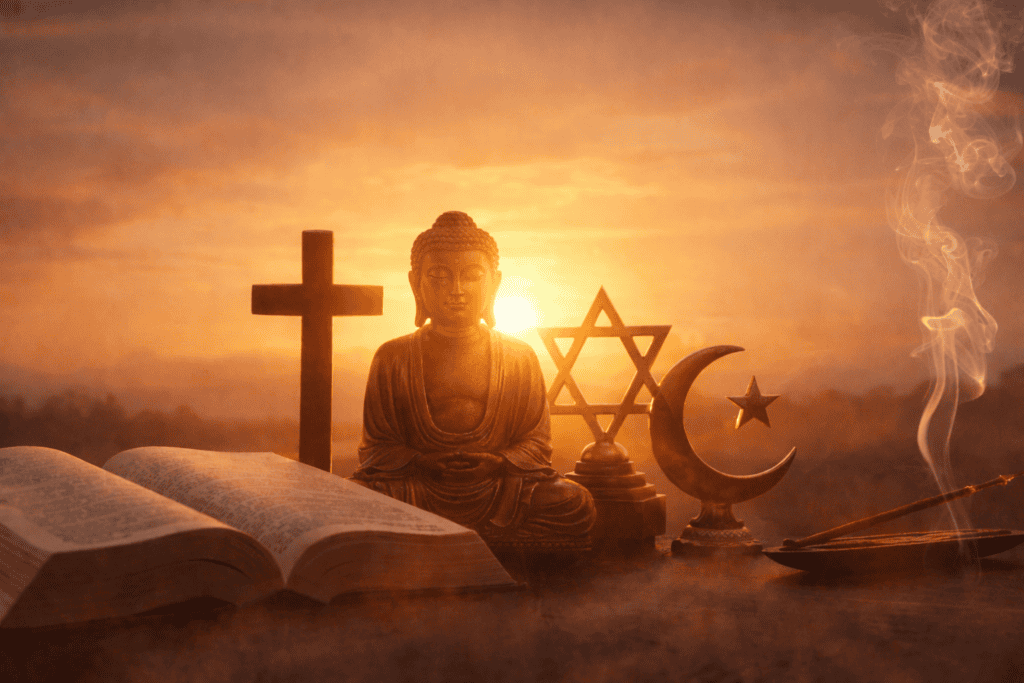
Another metaphor for the function of a symbol is that of a window, in this case a window to the absolute. Like any window, it both allows those inside to see the larger world outside and allows the light from outside to enter the world inside. In other words, the symbol functions like a two-way street, allowing the transcendent realm to reach the finite and giving the finite a way to the transcendent. This all becomes more understandable when we get to concrete examples. I’ll focus here on four of the religions I work with most frequently: Judaism, Christianity, Islam, and Buddhism.
In Judaism the central symbol is clearly the Torah, both in the narrower sense of the first five books of the Bible and in the broader sense of the teaching, Judaism’s basic message. If we name this symbol from the divine side, then we celebrate the “matan Torah,” the gift of the Torah, the understanding of the Torah as God’s revelation to Israel. If, on the other hand, we name this symbol from the human side, then it is the way the people of the Mosaic Covenant are called to walk the path that links them with the God of the Covenant. Reading the texts of Judaism from this central symbol outward can help us experience the coherence of the tradition. It thus allows for a more prayerful reading as well.
Unlike Judaism, Christianity finds its central symbol, not in the sacred text, but in a person, Jesus the Christ, God’s Anointed One. Christ then is clearly the central symbol of Christianity. When named from the side of transcendence, Christ is the Word of God, the Light of God, the Son of God entering our human sphere. But this same Christ can also be named from the side of our humanity and then he is the Way to the Father, our model, our paradigm for a trusting response to God. Being aware of this two-fold character of the central symbol helps us to organize the complex list of christological titles that we’re faced with in the sacred texts constituting the Christian Testament. This in turn enables us to read the text more prayerfully, since we’re understanding the text in a direction, from a core to a periphery, from a central symbol outward.
In Islam, as in Judaism, the central symbol is the text itself, in this case the holy Quran. Both Judaism and Islam clearly reject the centrality of the prophet who transmits the message from God. Neither Moses nor Muhammed are to be the objects of divine worship nor should these two religions be named from their respective prophets. Judaism is not “the Mosaic religion” nor is Islam “Muhammedanism.” The Christian Testament contains various genres of literature, gospels and letters primarily. But in the Quran we sense ourselves addressed directly by the divine Revealer. This makes sense when we realize that the writings of the Christian Testament are primarily telling us about the Christ but the Quran speaks to us directly from its divine source. Thus our prayerful reading of the Quran is from the Quran itself outward, i.e., from the divine Revealer to the community receiving the revelation.
When Thomas Merton, on his life’s last pilgrimage, visits the great statues of the Buddha at Polonnaruwa in Ceylon, he speaks of their great smiles, “filled with every possibility, questioning nothing, knowing everything.” Surely Siddhartha Gautama, the historical Buddha, sitting in meditation, is the central symbol of Buddhism. All the Buddhist scriptures seem to resonate from that core image, sending out those same waves that Merton felt in the smiling statues at Polonnaruwa. Our prayerful reading of the texts is enhanced when we read them from this direction, from this central symbol outward.
The Myth
I’ve heard it said that Paul Tillich would sometimes pound his professorial podium and shout at his American class: “Never say, ‘only a symbol’!” As we have seen in our recent discussion, symbols are not deficient realities; they are quintessential realities. For symbols link us with the deepest mystery, the very Ground of Being. By the same token, in the language of comparative religious study, myths aren’t mere fables but symbols in narrative form. This opens further for us the sacred texts we are engaging through our prayerful reading and the traditions they articulate. Not only can these texts and traditions be read from the central symbol outward but we find that this symbol is itself expressed in a narrative form, a story. Again, it helps to look at this concretely.
We have discussed the Torah as the central symbol of Judaism. Now as we look through the prism of the Torah, we grasp the central myth as well. It is, of course, the story we call “the exodus.” The Jewish community chose this Greek title for the second book of the Torah when Jewish scholars translated the texts from Hebrew to Greek around the second century BCE in the thriving city of Alexandria. Exodus means “the way out.” If you drive around in Greece, every exit ramp is named “exodus” and that same word is stamped on your passport when you leave the country.
Israel’s central story is an exodus, a way out, a freeing up from the slavery of Egypt and a freeing up for a covenanted life with God. Both aspects of this experience are important, since it would not make much sense to be freed up from slavery only to die in the desert of meaningless wanderings. Thus the first part of the story is the exciting narrative of escape. We think of Miriam, Moses’ sister, leading the Hebrew women in the ancient verse: “Sing to the Lord, for He has triumphed gloriously; horse and rider He has thrown into the sea.” The other side of the story, of course, is when the people stand at Sinai and receive the Ten Commandments, thus entering into a covenanted relationship with God.
Christianity sees this drama replayed in the death and resurrection of Christ. The initiatory rite of Christian baptism is one in which the candidate goes down into the waters and emerges reborn. The transition is both from slavery to freedom, a crossing of the Sea of Reeds, and a participation in the death and resurrection of Christ. This narrative of the path from death to new life is the central myth or story of Christianity. It takes two basic forms among Christians today, as it did in the first century world of the Jesus believers as well. One type of Christianity, identified more with Paul, stresses the death of Jesus as the crucial …factor in this transition from death to life; another type of Christianity, linked in ancient times with the name of Thomas, understands this crucial movement as residing primarily in Jesus’ teachings about taking up the cross and losing one’s life to find it. In both cases, however, the movement from death to life characterizes the central myth.
The Quran urges us to recognize God in his signs. The very chanting of the Quran is such a sign. As we come to recognize God in his signs, our response is one of total submission. Submission, of course, is the actual meaning of the word Islam. A Muslim, quite simply stated, is one who submits to God. The myth then is the story of every human being who recognizes God in the signs of the created world and in the sign of the revealed Word of the Quran and who then submits to this transcendent Revealing God, this one God, Allah, whose prophet is Muhammed. It is the prophet himself who most clearly exemplifies this recognition of signs and consequent submission. Nevertheless, the central myth is not his story alone, but the timeless human story of recognition and submission. Islam understands itself, after all, not as a new religion, but as a final restatement of the one religion given to humankind from the days of Adam.
In Buddhism, Siddhartha Gautama is but one of a myriad of buddhas. The story is not his alone but belongs to all of us. He made the transition from sleep to full wakefulness. The title “Buddha” means “the one who woke up.” We are all called to embody this quality of being awake. The silent and seated Buddha reminds us that the story takes place within our minds, in consciousness itself. For it is there that we realize the Four Noble Truths: that life has an unsatisfactory character (suffering); that our lack of satisfaction is rooted in illegitimate expectations (clinging); that this realization of the connection between clinging and suffering has within it the secret of the cessation of suffering (release); and finally, the commitment to the eightfold path leading to this enlightenment and release: right perspective, right resolve, right speech, right conduct, right livelihood, right effort, right mindfulness, and right concentration.
The Ritual
If the symbol is our connecting link with the transcendent mystery and if the myth is the symbol in narrative form, then what is ritual but the community enactment of the myth? The ritual may express the central myth itself or one of the many facets of that central myth as it radiates within the literature and the tradition. A good ritual should neither need nor tolerate extensive rational interpretation and commentary. Nothing is more frustrating in a ritual context than fumbling through a sheaf of papers to find the right page and listening to endless explanations of what the community is doing. A good ritual should be self-evident; just experiencing it should communicate to you what’s happening. Losing that clarity is a sure sign of ritual degeneration. To concretize all of this, let us return to the four traditions we have been considering.
It is sometimes said that every great religion does something best. If that is the case, then the Jewish claim is easily established. To paraphrase a popular Passover song, if Judaism had given us only the Sabbath, “it would have been enough — dayyenu.” The Sabbath in its weekly rhythm celebrates the central myth of freedom. The environment of the home bespeaks the freedom of the participants in this ritual, for they do not eat standing like harried slaves but seated and at leisure. The opening gesture, the lighting of the Sabbath candles, reminds the participants that Israel was sanctified by the commandments that constitute its covenantal life and that the very lighting of the candles is the response to a mitzva, a commandment. The full twenty-four hours breathe the air of freedom, the freedom to let God be God and to lay aside our human enterprises.
What the Sabbath celebrates each week is ritualized in greater detail once a year in the Seder, the service that initiates the Festival of Passover. I have worked for some twenty years now with the Jewish students here at Lake Forest College as they prepare the Seder each spring. Every detail of the meal highlights one aspect of the story, the Haggadah. Unleavened bread reminds us of escaping slaves with no time for bread to rise, and bitter herbs put in our mouth the very taste of servitude. The same bread is eaten with a mixture representing the mortar used in the bricks the slaves were forced to make in Egypt. But freedom is celebrated too, for we sit at leisure as only free people can. And we eat green herbs as a sign of springtime hope. The rabbis say that the Passover is rightly celebrated when those who have taken part in the ritual feel that they have indeed left slavery and have stood at Sinai to receive the commandments leading to covenanted living.
The communion meal in Christianity parallels the weekly Sabbath celebration of Judaism, just as Easter parallels Passover. In an otherwise solar calendar, Easter and its allied celebrations depend on the moon. The feast is kept on the first Sunday after the first full moon that follows the vernal equinox. Pentecost is the seventh Sunday after Easter; Trinity Sunday is the Sunday after Pentecost; and Corpus Christi is the Thursday after Trinity Sunday. Thus all these feasts are movable ones, following the kind of patterns we see in the Jewish calendar which is an adjusted lunar calendar so that holidays fall in the same season, though not on the same date (Islam has an unadjusted lunar calendar and thus holidays can occur at any time of the year).
This business of calendars may seem far afield but I see them as closely allied to the central structure of symbol, myth, and ritual. Judaism’s calendar begins with the year of creation as it is calculated from the biblical records of genealogies and lifespans; Christianity begins its count of years with Jesus’ birth; and Islam places as its starting year the time of Muhammed’s flight from Mecca to Medina. Calendars then, and the flow of liturgical feasts they contain, are valuable points of insight into the respective traditions they embody. A calendar is the way we keep the year together, as well as the continuity from one year to the next. The rituals flowing from a religious calendar contrast sharply with the secular seasons reflected in our department stores where we move from pumpkins to turkeys to elves and bells, and then from hearts to colored eggs and bunnies, with a final flourish of fireworks in the summer.
In the communion meal, Christians remember their Lord in the breaking of the bread and the sharing of the cup. They are reminded of Jesus’ life as God’s servant, giving himself completely in love until his own body was broken and his very blood poured out. Thus they are reminded too that they are called to serve others, to love as Jesus loved and to live as Jesus lived. This mystery, celebrated weekly in many Christian churches, is given heightened attention in the yearly celebration of Easter, the holiest of the Christian holidays, the fullest expression of the movement from death to life, from crucifixion to resurrection.
I took one of my college classes to visit a nearby mosque. The imam was most gracious and, as he spoke with us, he did something that impressed us deeply. He talked about Islam as meaning “submission” and then he said that the central expression of this is the ritual prostration used in the prayers that are said five times each day. We had just witnessed a time of prayer and were still standing on the carpeted floor of the mosque. The imam knelt down and stretched himself out in the traditional prostration. When he stood up, he said to us: “This is Islam.” The action was so simple, so humble, and so revealing. It said more than any words he might have used. Such is the power of ritual. The prayers and prostrations constitute one of Islam’s five pillars. It would be difficult to imagine a more fitting ritual for Islam’s central myth and symbol.
The most essential Buddhist ritual is no more difficult to find. Buddhists of every variety — Japanese, Tibetan, Thai, Vietnamese, American — sit in meditation. It is a ritual that belongs to every spiritual path but to none more than Buddhism, whose founder woke up while seated under the Bo Tree. The techniques of meditation differ but in any of its varying forms it has certainly been Buddhism’s greatest gift to the world of religion, what Buddhism does best. Thomas Merton, master of western monastic disciplines, confessed after visiting several Buddhist centers that their monks seemed more advanced in this practice than most Christian monks.
Here in the Interfaith Center at Lake Forest College, it is our central ritual act. Three times a week students gather for twenty minutes of non-cognitive meditation. Students soon learn to find a comfortable posture with their backs straight and their eyes closed. We use a mantra to focus our thinking mind, repeating the phrase: “Om, Shanti, Peace, Shalom” (the sound of the universe; the Sanskrit word for peace; the English and Hebrew words for that same deep peace). At the end of the meditation we say a blessing — that we ourselves, our friends, our enemies, and all beings may be happy, free, and at peace. This is something all our students can share: Protestants, Catholics, Jews, Muslims, Buddhists, and those with no particular religious convictions or commitments. It is a truly universal home for the human spirit. Although I don’t believe in any spiritual panacea, meditation is what I would recommend for most anyone’s first step on a spiritual path.
The Fruit
My parents took me to New York City when I was about twelve years old. We attended a solemn high Mass at St. Patrick’s Cathedral with Cardinal Spellman presiding. I remember turning to my Protestant father and saying something about the impressive character of all that was transpiring. My father answered, “I don’t recall Jesus saying a great deal about any of this pageantry but he did say something about everything being known by its fruits.” That telling comment serves as a good introduction to this final section of our exploration of spirituality. Much that goes by the name of spirituality today seems to be little more than another kind of narcissism. True spirituality is known by its fruits and those fruits are wisdom and compassion.
We spoke of wisdom earlier, pointing out its unique characteristic of organizing knowledge in terms of a larger framework. So much of what constitutes modern life comes in isolated packages. Issues don’t seem to touch. Experience is isolated and alienated. We hear so much about increased networks of communication and yet many of us continue to fear that the speed of moving essentially trivial and transient information will not affect the content. We are being buried in the detritus of what we call sound “bits” (an abbreviation of binary digits). But our thirst for spirit remains unshaked by this stream of digital signals.
Wisdom relates intimately to the pattern of symbol, myth, and ritual we described. Once we come to grasp the wholeness of a spiritual tradition in its texts and in its practices, understanding it outward from its central symbol and the narrative expression of that symbol in the myth that is then concretized in ritual, we are on the path of wisdom. We have a way of living whole and integrated in the world. We have a basis for discernment, separating wheat from chaff, the transient from the abiding, the passing fad from the deeper current.
Wisdom flows as naturally into compassion as a tree bears fruit. This compassion is not a patronizing form of taking pity on someone. It is rather a true fellow feeling for the other stemming from a deep recognition that we are all one. Thomas Aquinas defined love as “willing the good of the other.” True compassion wills nothing but the other’s deepest good. Like Martin Buber’s I-Thou experience, it “feels from the other side.” In other words, we begin to truly experience reality from the viewpoint of the other, the one to whom we are speaking, the neighbor with whom we are relating in so many ways each day.
I love Zen Buddhism’s ten oxherding pictures. They depict the spiritual path in a series of drawings. The ox represents enlightenment and one begins by finding its footsteps, then actually seeing the ox, taming it, riding it home etc. After person and ox are both transcended, there is a return to the source of everything that is. And then, in the tenth and final picture, the person is once again in the world. Smiling, with food and wine jug slung over his shoulder, the person walks into the midst of the marketplace world. He is ordinary. Like Kierkegaard’s “knight of faith” he is indistinguishable from the other citizens of Copenhagen walking home carrying a goose for their Sunday dinner. The end is always “nothing special” or “ordinary living.”
Summary
As I reread these pages, I sense so much that has not been said but I hope that this will suffice to give some sense of how we might begin to allow space for the spirit both in our own personal lives and in our shared world. A spiritual friend or a support community are of great help. If such are not available, we may have to rely on the wisdom we can find in sacred books. Prayerful reading of these texts with a quiet receptivity to the mystery of holiness they contain begins to give our spirits space. So too does the simple practice of meditation, a quiet centering of our souls. Life becomes simpler, more ordinary, and yet somehow more satisfying. Boredom begins to disappear because each moment tends more to open our eyes in wonder. There are fewer uninteresting or unworthy people since we see them increasingly as belonging intimately to us and to all that we are. An environment of dialogue begins to turn competitors into allies. Sorrow is there to feel, more poignantly than ever perhaps, but it is less perceived as “suffering.” Compassion flows more freely from us and yet it too is nothing special. With the fourteenth century mystic, Dame Julian of Norwich, a deep faith grows in us that “all will be well, all will be well, every conceivable thing will be well.”